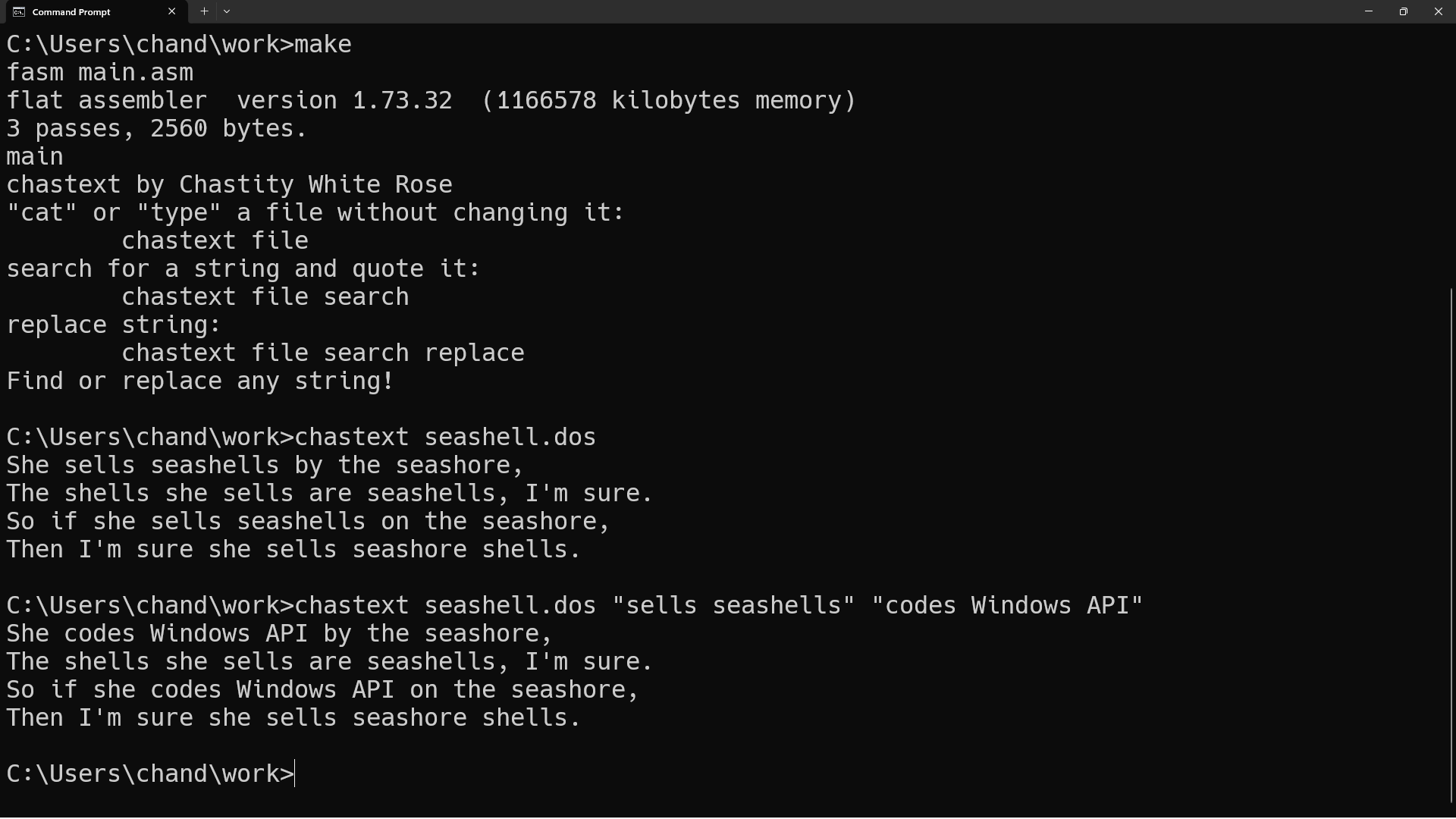
I know the code is kind of messy, but I translated the DOS version of chastext to Windows using Windows API calls. I had some good samples to copy paste from the Windows versions of chastehex and chastecmp.
Maybe some time I can find a more convenient way of managing the command line arguments but my custom routine is doing the trick to allow argument strings containing multiple words if they are surrounded by quotes. Windows and DOS are a lot harder in this regard because they don't filter them automatically like Linux does. I am so spoiled by how easy Linux makes assembly that Windows was a real challenge. However, I like a challenge of this sort.
;chastext is a generic find and replace program for text files
;using it is very simple because it only requires 3 arguments
;
;chastext filename "search string" "replacement string"
;
;It does not do regular expressions like sed but it is useful
;I use it when I need to change the name of a variable in a program
;or when I am modifying configuration files.

format PE console
include 'win32ax.inc'
include 'chastelibw32.asm'

main:

mov [radix],10 ; Choose radix for integer output.
mov [int_width],1

;get command line argument string
call [GetCommandLineA]

mov [arg_string_index],eax ;back up eax to restore later

call strlen ;get the length of the string

mov ebx,[arg_string_index] ;mov the address of the string start into ebx
add ebx,eax                ;add eax which contains the length
mov [arg_string_end],ebx   ;move end of string address to permanent location

;optionally display the arg string to make sure it is working correctly
;mov eax,[arg_string_index]
;call putstring
;call putline

;set ebx back to the start of the arg string for the filter loop
mov ebx,[arg_string_index]

;now ebx points to the first non space character in the arguments passed to the DOS program
;and we know that [arg_string_end] is where it ends

;the next step is to filter the arguments into separate zero terminated strings
;each space will be changed to a zero (normally)
;but we also need to account for spaces inside quotes that are considered part of the string
;Linux handles this normally but DOS needs me to write the code to mimic this behavior
;because the program needs to function identically for DOS or Linux

mov cl,' ' ;set the default filter character (argument terminator) to a space
mov ch,0   ;are we currently checking spaces 0 or quote characters 1 as terminators?

;this loop is the new and improved argument filter
;it keeps track of whether we are inside or outside a quote
;and also which type of quote started the quote
;the actual quote marks are not part of the string unless they
;are the opposite quote type than what started the string
;The important thing is that spaces can exist inside of quoted strings
;as one argument rather than each new word being a new argument
;could be important for filenames containing spaces, etc.

argument_filter:

cmp ebx,[arg_string_end] ;are we at the end of the arg string?
jz argument_filter_end       ;if yes, stop the filter and terminate with zero

cmp ch,1       ;are we inside a quoted string?
jz quote_check ;if yes, don't do anything to the spaces

cmp byte[ebx],cl ;compare the byte at address bx to the string terminator
jnz ignore_char ;if it is not the same, we ignore it
mov byte[ebx],0  ;but if it matches, change it to a zero
ignore_char:

cmp byte [ebx],0x22 ;is this a double quote -> "
jz start_quote
cmp byte [ebx],0x27 ;is this a single quote -> '
jz start_quote
jmp quote_no ;it was not a quote

start_quote:

mov ch,1    ;set ch to 1 to set that we are inside a quote now
mov cl,[ebx] ;save this quote type as the new terminator
mov byte[ebx],0 ;but delete the first quote with zero

;check for single or double quotes
quote_check:

cmp [ebx],cl ;is this character the same type of quote that started this sub string?
jnz quote_no ;if it is not, then skip to quote_no section

;but if it was matching, change this byte to zero
;and change cl back to a space
mov cl,' ' ;cl is now a space
mov ch,0   ;ch is 0 because now we have ended the quoted string
mov byte[ebx],0 ;delete the end quote with zero

quote_no:

inc ebx ;go to the next character
jmp argument_filter   ;jump back to the beginning of argument filter

argument_filter_end:
mov byte [ebx],0 ;terminate the ending with a zero for safety

;check first argument which is name of program
;mov eax,[arg_string_index]
;call putstr_and_line

call get_next_arg ;get address of next arg and return into eax register
cmp eax,[arg_string_end] ;if there is no filename arg, we end
jnz args_exist

mov eax,help    ;if no arguments were given, show a help message
call putstring
jmp ending     ;and end the program because there is nothing to do

args_exist:

mov [filename],eax
;call putstr_and_line ;print filename before text output

;This is where the main part of the chastext program really begins.;

;now that the argument string is prepared, we will try to use the first argument as a filename to open

;https://learn.microsoft.com/en-us/windows/win32/api/fileapi/nf-fileapi-createfilea
;https://learn.microsoft.com/en-us/windows/win32/secauthz/generic-access-rights

;open first file with the CreateFileA function

push 0           ;NULL: We are not using a template file
push 0x80        ;FILE_ATTRIBUTE_NORMAL
push 3           ;OPEN_EXISTING
push 0           ;NULL: No security attributes
push 0           ;NULL: Share mode irrelevant. Only this program reads the file.
push 0x80000000  ;GENERIC_READ access mode
push [filename] ;
call [CreateFileA]

;check eax for file handle or error code
;call putint
cmp eax,-1
jnz file_ok

mov eax,file_error_message
call putstring
call [GetLastError]
call putint
jmp main_end ;end program if the file was not opened

;this label is jumped to when the file is opened correctly
file_ok:

mov [filedesc],eax

;before we proceed, we also check for more arguments.

call get_next_arg ;get address of next arg and return into eax register
cmp eax,[arg_string_end] ;if at end, no search string argument
jz textdump ;jump to textdump section

;otherwise, we save the address at ax to our search string
mov [string_search],eax
;call putstr_and_line


call get_next_arg ;get address of next arg and return into ax register
cmp eax,[arg_string_end] ;if at end, no replacement string argument
jz textdump ;jump to hexdump section

;otherwise, we save the address at ax to our replacement string
mov [string_replace],eax
;call putstr_and_line

;all other arguments that may exist after this are irrelevant

textdump:

;this is the beginning of the textdump main loop of chastext

;first, check to see if there is a search string
;if there is a search string, skip the normal putchar

cmp dword[string_search],0 ;do we have a search string?
jnz putchar_skip

;but if there is not a search string
;we will read one character, then display it to stdout
;and then jump to the beginning of the textdump loop to print them until EOF
;we start the loop with a call to read exactly 1 byte

;read only 1 byte using Win32 ReadFile system call.
push 0              ;Optional Overlapped Structure
push bytes_read     ;Store Number of Bytes Read from this call
push 1              ;Number of bytes to read
push byte_array     ;address to store bytes
push [filedesc]     ;handle of the open file
call [ReadFile]

mov eax,[bytes_read]

cmp eax,1        ;check to see if exactly 1 byte was read
jz file_success ;if true, proceed to display
;mov ax,end_of_file
;call putstring
jmp main_end ;otherwise close the file and end program after failure

; this point is reached if 1 byte was read from the file successfully
file_success:

mov al,[byte_array]
call putchar
jmp textdump

;if search string doesn't exist, just jump and repeat the loop
;otherwise we continue into the next section that compares the input with the search string

putchar_skip:

;this is the beginning of search mode
;it handles the file by seeking and reading to search every position for the search string

;first, seek to the file_address we initialized to zero
;this variable will be added to depending on actions taken

;seek to address of file with SetFilePointer function
;https://learn.microsoft.com/en-us/windows/win32/api/fileapi/nf-fileapi-setfilepointer
push 0             ;seek from beginning of file (SEEK_SET)
push 0             ;NULL: We are not using a 64 bit address
push [file_address] ;where we are seeking to
push [filedesc] ;seek within this file
call [SetFilePointer]

;obtain the length of the search string using my strlen function
mov eax,[string_search]
call strlen ;get the length of the search string

mov ecx,eax ;store this length in ecx
mov [search_length],ecx

;call putint_and_line ;check length of search string

;use the length of the string we are searching for as the number of bytes to read at this location

;Win32 ReadFile system call.
push 0              ;Optional Overlapped Structure
push bytes_read     ;Store Number of Bytes Read from this call
push ecx            ;Number of bytes to read
push byte_array     ;address to store bytes
push [filedesc]     ;handle of the open file
call [ReadFile]

mov eax,[bytes_read]  ;get how many bytes were read with that last read operation

mov ebx,byte_array    ;move the address of bytes read into bx
add ebx,eax           ;add number of bytes read (return value of read function in eax)
mov byte[ebx],0       ;terminate the string with zero

cmp eax,[search_length] ;if the number of bytes is not what we expected to read, end this loop
jnz textdump_end

;move our two strings into the esi and edi registers for comparison
;with my custom written strcmp function

mov esi,[string_search]
mov edi,byte_array
call strcmp ;compare these two strings

cmp eax,0 ;test if they are the same (if eax returned zero)
jnz not_match ;if they are not a match go to that section for printing a character

;but if they are a match, then we either quote them
;or replace them if a replacement string is available

;but regardless of which action we do, since a match was found, let us add this count to the file address
;so that we read from beyond this point next time the textdump loop starts
mov eax,[bytes_read]
add [file_address],eax

cmp dword[string_replace],0 ;check to see if a replacement string is available
jz print_quotes ;if not, skip to the part where we just quote the strings that match

;otherwise, we will print the replacement string instead of the original!

mov eax,[string_replace]
call putstring ;print the string

jmp textdump ;restart the main loop

print_quotes:
;print quotes around matched string
mov al,'"'
call putchar

mov eax,byte_array
call putstring ;print the string

mov al,'"'
call putchar

jmp textdump ;restart the main loop

not_match:

mov al,[byte_array]
call putchar
add [file_address],1 ;add 1 to the file address so we don't read this same position again

jmp textdump

textdump_end:

;print the remaining bytes, if any, left after the main loop ended
mov eax,byte_array
call putstring

main_end:

;this is the end of the program
;we close the open file and then use the exit call

;close the file
push [filedesc]
call [CloseHandle]


ending:
;Exit the process with code 0
push 0
call [ExitProcess]

.end main

arg_string_index  dd 0 ;start of arg string
arg_string_end    dd 0 ;address of the end of the arg string

;function to move ahead to the next art
;only works after the filter has been applied to turn all spaces into zeroes
get_next_arg:
mov ebx,[arg_string_index]
find_zero:
cmp byte [ebx],0
jz found_zero
inc ebx
jmp find_zero ; this char is not zero, go to the next char
found_zero:

find_non_zero:
cmp ebx,[arg_string_end]
jz arg_finish ;if ebx is already at end, nothing left to find
cmp byte [ebx],0
jnz arg_finish ;if this char is not zero we have found the next string!
inc ebx
jmp find_non_zero ;otherwise, keep looking

arg_finish:
mov [arg_string_index],ebx ; save this index to variable
mov eax,ebx ;but also save it to ax register for use
ret
;we can know that there are no more arguments when
;the either [arg_start] or eax are equal to [arg_end]

;the strlen and strcmp are named after the equivalent C functions
;but are written from scratch by me based on their expected behavior

;a function to get the length of string in eax and return the integer in eax

strlen:

mov ebx,eax ; copy eax to ebx. ebx will be used as index to the string

strlen_start: ; this loop finds the length of the string as part of the putstring function

cmp [ebx],byte 0 ; compare byte at address ebx with 0
jz strlen_end ; if comparison was zero, jump to loop end because we have found the length
inc ebx
jmp strlen_start

strlen_end:
sub ebx,eax ;subtract start pointer from current pointer to get length of string

mov eax,ebx ;copy the string length back to eax

ret

;strcmp compares the string at esi to the one at edi
;ax returns 0 if the strings are the same and 1 if different
;the algorithm is simple but I will explain it for those who are confused

;eax is initialized to zero
;a byte from each string is loaded into the al and bl registers
;the bytes are compared. if they are different, then we jump to the end
;However, if they are the same, then we check if one of them is zero
;for this purpose it doesn't matter whether we compare al or bl with zero
;because it is known that they are the same if the jnz did not take place
;if it is zero, this also jumps to the end of the function
;If neither jump took place, then we jump to the start of the loop
;but when the function finally ends bl will be subtracted from al
;this ensures that the function returns zero if the final characters are the same

strcmp:

mov eax,0

strcmp_start:

;read a byte from each string
mov al,[edi]
mov bl,[esi]
cmp al,bl
jnz strcmp_end

cmp al,0
jz strcmp_end

inc edi
inc esi

jmp strcmp_start

strcmp_end:
sub al,bl

ret

help db 'chastext by Chastity White Rose',0Dh,0Ah
db '"cat" or "type" a file without changing it:',0Dh,0Ah,9,'chastext file',0Dh,0Ah
db 'search for a string and quote it:',0Dh,0Ah,9,'chastext file search',0Dh,0Ah
db 'replace string:',0Dh,0Ah,9,'chastext file search replace',0Dh,0Ah
db 'Find or replace any string!',0Dh,0Ah,0

file_error_message db 'Could not open the file! Error number: ',0
filename dd 0
filedesc dd 0
file_address dd 0 ;file address defaults to zero AKA beginning of file
end_of_file db 'EOF',0

;where we will store data from the file
bytes_read dd 0

search_length dd 0
string_search dd 0 ; place to hold the search string pointer
string_replace dd 0 ; place to hold the replacement string pointer

byte_array db 0x73 dup 0
 Index
> Windows > chastext for Windows Assembly
Index
> Windows > chastext for Windows Assembly

 24 May 2026, 13:41


